Tuesday, 26 September 2023

Giant Reeds, Eucalyptus Trees and Rubbish Destroy a River in Portugal

Ribeira do Marchante is a vanishing river


There is a river in Quinta do Conde in Portugal known as the Ribeira do Marchante or the Ribeira de Coina. It was once a navigable river that had a lot of water and even supported rice fields back in the 1800s. Today it can be difficult to see, and difficult to find any stretches of water that are not choked with Giant Reeds (Arundo donax) and other vegetation.

In the droughts that are now a new normal in Portugal due to Climate Change, the bed of this river is often dry for much of its course, and for much of the year. Rubbish and fly-tipping litter its banks and surrounding areas.

Some of this trash is in the river itself. This river is disappearing. The land next to it has many Eucalyptus trees. They are known to take a lot of groundwater from any land they are growing in. This non-endemic tree is adding to the threats to the river’s health. I have lived in Quinta do Conde for eight years and have seen the Ribeira do Marchante in much better condition in the first years I was here. In the past I have seen ducks swimming on it, Iberian Water Frogs (Pelophylax perezi)

in many parts, and I have even seen a rare European Pond Tortoise (Emys orbicularis) dive into the water. On World Rivers Day (24 September), with the EcoGrupo Trevo, local environmental conservation group, I went walking the route of the Ribeira do Marchante, including a part that I was not familiar with. I was horrified to see how much Giant Reed is now growing in and along the river. If it continues like this there will be no water flowing. The Giant Reed is an invasive species and creates problems in many parts of the world. It is resistant to fires because it can regenerate, it uses up a lot of water, its roots go deep into the soil making it hard to remove, it spreads rapidly, it grows very quickly, and it displaces native vegetation while destroying wildlife habitat. As for the Eucalyptus trees, several years ago a team of men cut down some of the trees near the Sports Stadium, which is close to the river. However, they left the stumps and soon after the trees sprouted again. 

The Eucalyptus recovers quickly when felled, and also regenerates after being burned in wildfires. This tree is causing a big problem in many parts of Portugal. In addition to all this, paths through the woodland on the banks of the river are being churned up by trail bike riders, people on 4-wheelers, and we even encountered a car actually driving along the riverbed in one part. All of this causes sand to wash down into the river in storms. My conclusion is that the Ribeira do Marchante needs help, and needs help urgently or it will continue to decline fast and will eventually be no more than a memory. I am a member of ESRAG (Environmental Sustainability Rotary Action Group) and this group is very concerned with restoration of rivers and wetland. There is an Adopt a River group. I am also an active member in SAVE THE FROGS! a charitable organisation that, as its name suggests, is dedicated to saving frogs and other amphibians worldwide. There are grants available from Rotary and from SAVE THE FROGS to fund the sort of work that would be needed to save the Ribeira do Marchante. I am hoping that the money can be found to fund a restoration project. I think something should be done to halt the destruction of this river before it is too late.

Portuguese:

A Ribeira do Marchante é um rio em extinção


Existe um rio na Quinta do Conde em Portugal conhecido como Ribeira do Marchante ou Ribeira de Coina. Já foi um rio navegável que tinha muita água e até sustentava campos de arroz no século XIX. Hoje pode ser difícil ver e encontrar trechos de água que não estejam obstruídos por Canas/Juncos gigantes (Arundo donax) e outras vegetações. Nas secas que são agora uma nova normalidade em Portugal devido às Alterações Climáticas, o leito deste rio fica frequentemente seco durante grande parte do seu curso e durante grande parte do ano. Lixo e despejos espalhados pelas margens e áreas adjacentes. Parte desse lixo está no próprio rio. Este rio está desaparecendo. O terreno ao lado possui muitos eucaliptos. Sabe-se que retiram muita água subterrânea de qualquer terreno onde crescem. Esta árvore não endémica está a aumentar as ameaças à saúde do rio. Moro na Quinta do Conde há oito anos e vi a Ribeira do Marchante em muito melhores condições nos primeiros anos que aqui estive. No passado, vi patos nadando nele, rãs d'água ibéricas (Pelophylax perezi) em muitas partes, e até vi uma rara tartaruga europeia (Emys orbicularis) mergulhar na água.

No Dia Mundial dos Rios (24 de Setembro), com o EcoGrupo Trevo, grupo local de conservação ambiental, fui percorrer o percurso da Ribeira do Marchante, incluindo uma parte que não conhecia. Fiquei horrorizado ao ver quanto Cana está crescendo agora dentro e ao longo do rio. Se continuar assim não haverá água fluindo. A Cana é uma espécie invasora e cria problemas em muitas partes do mundo. É resistente ao fogo porque pode se regenerar, consome muita água, suas raízes penetram profundamente no solo dificultando sua remoção, se espalha rapidamente, cresce muito rapidamente e desloca a vegetação nativa ao mesmo tempo que destrói o habitat da vida selvagem. Quanto aos eucaliptos, há vários anos uma equipa de homens derrubou algumas árvores perto do Estádio Desportivo, que fica perto do rio. Porém, eles abandonaram os tocos e logo depois as árvores voltaram a brotar. O eucalipto se recupera rapidamente quando derrubado, e também se regenera após ser queimado em incêndios florestais. Esta árvore está a causar um grande problema em muitas zonas de Portugal.Além de tudo isso, os caminhos pela mata às margens do rio estão sendo agitados por ciclistas de trilha, pessoas em veículos de quatro rodas, e até encontramos um carro passando pelo leito do rio em um trecho. Tudo isso faz com que a areia desça para o rio durante as tempestades. A minha conclusão é que a Ribeira do Marchante precisa de ajuda, e precisa de ajuda urgentemente ou continuará a diminuir rapidamente e acabará por não passar de uma memória.Sou membro do ESRAG (Grupo de Ação Rotary para Sustentabilidade Ambiental) e este grupo está muito preocupado com a restauração de rios e zonas húmidas. Existe um grupo Adote um Rio.

Também sou um membro ativo do SAVE THE FROGS! uma organização de caridade que, como o próprio nome sugere, se dedica a salvar sapos e outros anfíbios em todo o mundo. Existem subsídios disponíveis do Rotary e da SAVE THE FROGS para financiar o tipo de trabalho que seria necessário para salvar a Ribeira do Marchante. Espero que o dinheiro possa ser encontrado para financiar um projeto de restauração. Penso que algo deveria ser feito para impedir a destruição deste rio antes que seja tarde demais.

Tuesday, 14 February 2023

The Magic of Butterflies and Moths is a new Moon Books title

The Magic of Butterflies and Moths is my new book


The Magic of Butterflies and Moths is my latest book published by Moon Books. It will be available on 24 February 2023, but it can be preordered now. As the title suggests I take a look at what can be considered as magical about these amazing insects. Everyone is familiar with the incredible transformation from egg to caterpillar to chrysalis and then to adult butterfly but there are many more astounding facts about butterflies and moths. 

Swallowtail caterpillars

I first became fascinated by these insects when I was a little boy. I used to keep caterpillars in jam jars and other containers. I learned then that you had to feed the larvae with the right types of plants. I also learned that some chrysalises and pupae have a short time before they emerge as adults, while others must wait many months and go right through the winter and the spring months before eclosing in early summer. Many species of butterfly and moth embark on lengthy migrations at specific times of the year. They can fly incredibly long distances and cross seas. The Monarch is probably most famous of all for its annual migration from the lower part of Canada and the most northerly American states right down to Florida, California and Mexico. It overwinters in the south and in the spring it begins the migration northwards. 


Monarch butterfly

I take a look at butterflies that live in the most inhospitable areas where you would probably think these insects cannot be found. But there are butterflies that live within the Arctic circle, in Lapland and Siberia. Some butterflies have extraordinary life cycles. There are species of Blue butterfly that depend on specific species of ants finding their caterpillars. The ants take the caterpillars into their nests where when fully grown the butterfly larvae become chrysalises. The very rare Large Blue is a species that is like this. 

Many species of butterfly and moth employ elaborate camouflage as adults and as caterpillars to help protect them from predators. When their wings are folded some species look like dead leaves as adults, some caterpillars look like twigs. Other types have displays and warning colours of bold contrasting hues that are a signal that says “do not eat me because I will poison you!” There are moth species that cannot feed as adults, there are many others in which the females are not only unable to eat but they cannot fly either. Yet the caterpillars of these species are some of the most gaudy and exotic looking of all. Some moths, such as the weird looking Death’s-head Hawk-moth have become the subject of superstitions. Because it has an odd skull-like marking on its thorax and because it has weird behaviour such as the ability to squeak, this moth was regarded as a bad omen. 


Death's-head Hawkmoth

As well as the appearances and behaviour of many species of butterfly and moth I take a look at what we can do to help them. There is a chapter devoted to butterfly gardening, as well as a list of some organisations where you can find out more about butterfly (and moth) conservation. 

The Magic of Butterflies and Moths has some wonderful endorsements from people such as Rebecca of Rebecca’s Butterfly Farm who said: “Lovely stories and lots of amazing facts.” Paul Hetherington, Buglife Director of Fundraising and Communications described my book like this: “The Magic of Butterflies and Moths is just what is needed to help people understand and have friendlier relationships with these incredible insects, a major goal of our No Insectinction campaign.” 

My book will be available from Amazon.com and Amazon.co.uk as well as many other book suppliers around the world. Just Google “Steve Andrews The Magic of Butterflies and Moths” and pick up your copy. 


Tuesday, 20 September 2022

Songs for World Peace are good for the world of nature too

Songs for World Peace benefit the environment and animals too


Tomorrow is International Peace Day and I am one of many artists worldwide taking part in the Wake Up, Rise Up, LIVE4Peace concert. I knew I wanted to be involved in this as soon as I heard about it, and I always think that peace is not just what humans need because it means a healthy environment in which animals benefit too. Consider war-torn Ukraine right now where countless abandoned dogs and cats are suffering and dying. Animals in a war-zone, besides being terrified, can easily get lost if they run away in fear, and others sadly get abandoned by people who have to leave where they have been living in a hurry. Many cats and dogs get trapped in buildings, some get seriously wounded and killed, just like people can too.

War brings death and destruction. With gunfire and rockets being fired, there is often no let up for days. Think about how scared pet dogs and cats get on the one night of Bonfire Night, and by celebratory fireworks. In a war the loud noises and explosions don’t stop after a few hours.

Wars can destroy forests and wildlife habitats too. I am thinking of the horror of what happened with the spraying of Agent Orange herbicide in the war against Vietnam in the 1960s and early 1970s. The U.S. military used the poisonous substance as a defoliant so there was no longer any cover or hiding places created by the trees. It worked well from the point of view of destroying forest trees but it also drastically reduced biodiversity and had long lasting harmful effects on millions of humans who were exposed to the chemicals. Dioxins from Agent Orange persist in the environment causing harm to man and beast. The herbicide is associated with many forms of cancer and with birth defects. Agent Orange was also used on agricultural land to destroy crops.


Far more recently there was a lot of worry about the Russian forces in the Chernobyl area. Chernobyl has become noted as a region contaminated with nuclear radiation that caused humans to abandon it but where over the years, the world of nature has reclaimed the land and very many species of fauna and flora have been living. In some cases it is said that there are more of some types of animal living there now than when people were living in the nearby city of Pripayat.

It was feared that the recent Russian occupation of Chernobyl could undo everything, and that the area could become highly contaminated again and a threat to surrounding parts of the world. War is a very great danger to the world of nature as well as to the world of humans, and that is why I am singing for peace. Wake Up, Rise Up, LIVE4Peace have arranged it so that artists taking part can collect donations towards any charities of their choice. I have chosen The Rotary Club of Wyndham Harbour, which I am a member of. Rotary Clubs worldwide have world peace as one of the many goals being worked for. Please join us in taking action for peace. Even thinking peace, is a good place to start, which is why the late John Lennon, who was famous not only for being one of The Beatles but for his peace-campaigning with his wife Yoko Ono, advised us to THINK PEACE! 

Tuesday, 13 September 2022

The Death’s-head Hawk-moth must have a very difficult life

The mysterious life of the Death’s-head Hawk-moth

Death’s-head Hawk-moth. Photo: Steve Andrews

The Death’s-head Hawk-moth (Acherontia atropos) is a very remarkable insect in many ways. Once seen it will never be forgotten with its skull-like marking on the back of its thorax, dark but beautifully patterned wings, its massive size, and stout furry banded body. But this hawkmoth must lead a very difficult life, and it doesn’t surprise me that it is rare. The Death’s-head Hawk-moth’s main food is apparently honey and it steals this from beehives. It is even known as the “Bee Robber.” So one of the first things the insect must do in its life is locate a hive, not so easy these days with the terrible decline in honeybees, said to be due to Colony Collapse Disorder. It then has to enter the home of the bees, find the honeycomb and use its short proboscis to break through the wax to steal the sweet liquid.

There are theories about how it manages to do this without being attacked by angry bees. One theory is that it emits a smell that causes the bees to leave it alone because it mimics the scent of the bees. It appears that the moth requires the stimulus of being in a hive to go about feeding. In captivity if supplied with honey on a pad it won’t touch this. Websites with details of caring for the moth say that the only way to feed it is to carefully hold the insect and unroll the proboscis so that it goes into a mixture of honey and water. Although the moths will struggle, it is said that after one or two attempts they will learn to feed this way and will take their food on future days. I cannot confirm this because I have to admit I have given up with my attempts and have released moths in my care. The Death’s-head Hawk-moth also squeaks quite loudly when alarmed, and it is definitely alarmed when held for attempted force feeding. My question is why won’t it feed itself? Otherwise in published literature there is very little information about how the adults feed. In a very few places I have read that they also take tree sap and resin, have been known to puncture fruit, accept rotting fruit,  and even that they take the nectar from a Petunia flower, not the normal way but by breaking into the part of the flower that holds the nectar. I have left a moth with a pad soaked in honey and water, and also with Petunia flowers and the moth ignored all of it. Literature on these moths also maintain that this hawkmoth will not attempt to mate until the males have fed and until a few days have gone by. So even if you have males and females emerging around the same time it is still not easy to get them to mate. You have to find a way to feed them, and need somewhere to keep the insects safely where they do not damage their wings trying to escape. In my experience this moth emerges from its pupa at night and soon after the wings are dried it wants to fly. I have had them eclose in the early hours of the morning. I have read that the moth flies very late at night, and this appears to be correct. Researching the Death’s-head Hawk-moth fails to turn up much information that I haven’t given here. I am wondering whether these moths do feed otherwise but have not been studied well enough for anyone to know how they feed or what on.

  Death’s-head Hawk-moth caterpillar. Photo: Steve Andrews

The caterpillars are another matter though, and the information on them today is far, far greater than when I was a boy. Books on insects many years ago used to say the caterpillar fed on the foliage of the Potato, possibly on the Jasmine too, and that was about it. Nowadays the reported range these huge larvae can eat is very  wide indeed. Besides Potato and Jasmine, it is known to feed on Deadly Nightshade, Woody Nightshade, Snowberry, Thornapple, Tree Tobacco, Tomato, Hemp, Lantana, Olive, Privet, Lilac, Buddleia and Tulip Tree. I have found them on Thornapple in Tenerife and Lantana there. I suspect the caterpillar can also feed on Sea Grape because I encountered a wandering larva once in a shopping precinct where the only vegetation present was on some specimens of this tree. Unlike many species, the caterpillar of the Death’s-head Hawk-moth is almost spoiled for choice. Nevertheless I have found they don’t like to switch plants that they have been eating. Larvae reared on Privet expect more Privet. Besides the unusual feeding habits of the adult moths, I wonder what causes some of them to embark on lengthy migrations, including those in which it flies over the seas. This species has been found as far north as the Shetland Islands in the UK, but clearly could not withstand the winters up there, which would be far too cold. It is said that this species cannot get through winters in Britain elsewhere. What causes it to migrate? How does it decide which direction to fly? How does it find beehives? The Death’s-head Hawk-moth is a very mysterious moth don’t you agree?

Thursday, 1 September 2022

Could Lisbon play host to an Ocean Aid concert

 Is Lisbon the ideal city for an Ocean Aid concert? 

Steve Andrews interviewed at a Rock in Rio Lisboa concert

This summer, Lisbon was the city chosen to hold the UN Ocean Conference, a week-long event attended by thousands. Celebrities, including Aquaman star Jason Momoa, and oceanographer, explorer and author Dr Sylvia Earle, were among the many special guest speakers. There was extensive media coverage for the conference in which very great numbers of organisations concerned with saving the seas and the marine life in them took part.

went along to the event myself and came away feeling inspired, and thinking this: if Lisbon is where a United Nations conference can be held with the theme being saving the oceans, wouldn’t the city also make the perfect place to hold an Ocean Aid rock concert? I came up with the idea of Ocean Aid when I penned my song “Where Does All The Plastic Go?”

I have blogged about it before. I have talked about my idea in any media interviews I have had worldwide. I even have a book with a chapter all about it. Saving Mother Ocean, which was endorsed by Captain Paul Watson of Sea Shepherd, explains how I thought such an event could follow in the footsteps of Live Aid, but this time raising awareness about the many threats to the oceans and to raise funds for charitable organisations working on saving the seas.
I was thinking Lisbon would be perfect, not only for me because I live near the city, but far more importantly, because there are two well-known concert promoters here that stage really big all day outdoor music events. I am talking about Rock In Rio Lisboa and NOS Alive. I have been to Rock In Rio Lisboa concerts in Lisbon. One of the acts I saw here was Bruce Springsteen back in 2016. I mention “The Boss” because he is an example of the type of very high profile rock stars that have performed at a Rock in Rio concert. Concert organisers and promoters like Rock In Rio Lisboa and NOS Alive know what it takes to put on really big events. They know the sort of money that is needed, they know what it takes to successfully run such concerts, they have the right contacts in the music industry. And, again very important, there are parks in Lisbon that can be used to stage these events. In other words, we have it all here, everything that would be needed to put on an Ocean Aid Lisboa concert. I would choose Sea Shepherd to be the charity that funds could be raised for. Mick Jagger, Coldplay and Steven Tyler, are some very big name acts that I know support this organisation. As it happens, Coldplay are already going to be playing four concerts here in Portugal next year. Wouldn’t it be amazing if they also performed an Ocean Aid concert? I need to get my idea to the right people. I have tried sending messages to Rock In Rio and to NOS Alive but no replies as yet. I am sure they get thousands of people contacting them, so I am not that surprised I have had no response. Maybe this blog will get seen by someone from Rock In Rio Lisboa or NOS Alive, maybe some other big concert organiser will see it? If they do, hopefully they will like my idea and will help me make an Ocean Aid concert a reality in Portugal?

Sunday, 31 July 2022

Testing positive for plastic, so is there a plastic pandemic?

Besides the Covid pandemic are we also the victims of a plastic pandemic?

It is worrying enough testing positive for Covid-19 and the pandemic has caused so much suffering and deaths around the world, but what if there is another form of pandemic that people do not know about? I am not talking about one that we can be vaccinated against. What if there is a plastic pandemic, not caused by a virus but by nano-plastics in the bloodstream? I was already well aware that micro-plastics and nano-plastics are being found everywhere, and I mean everywhere, so it didn’t surprise me that plastic has been found in human blood. We are consuming plastic in our food and drink and in the air we breathe. Most of this plastic we cannot see and are unaware of. The scale of this is unknown but it is happening increasingly, and now there are people who have tested positive for plastic. I was recently at the UN Ocean Conference in Lisbon, and there were two guest speakers there who are some of the first people in the world who have gone through the alarming experience of finding they test positive for plastic in their bloodstream. Jo Royle, founder of Common Seas was one of them and Ben Jack, programme director for Common Seas was the other. They know that they are living with plastic circulating in their bodies. Scientists testing for plastic have discovered that as many as 77% of those tested were found to have the material in their blood. It is unknown as to what effect plastic in our bloodstreams can cause. Will the material lodge in organs and tissues, will this cause harm, how will the body attempt to remove the plastic, are some of the questions that spring to mind. Do plastic particles in the blood lead to blood clots? Of course, the main problem is that plastic was made to last forever, it was made so it doesn’t decompose. What it does do is it breaks down into smaller and smaller pieces, and this is how nano-plastics are eventually formed. The planet has been contaminated by them. Dust fine plastic can be blown in the wind, carried in raindrops, end up on mountain tops and in the ice in polar regions. Plastic pollution is one of the most serious threats to life on this planet. Big pieces get swallowed by animals on land and at sea and can kill the unfortunate creatures, other animals die after getting trapped and entangled in plastic netting, but what harm micro and nano-plastics currently do, or in the long term, we cannot presently say. It is an international problem and we all need to take personal action in any way we can to help tackle the problem of plastic pollution. I took action by writing the song “Where Does All The Plastic Go?” and the book Saving Mother Ocean.

In my song I sing: “Plastic kills the turtles and is eaten by the fish, plastic is in the food chain and the dinner on your dish. Where does all the plastic go, into the sea, into the sea, how did it get there, who threw it away, was it you or was it me?”

Sunday, 24 July 2022

Aquaman star Jason Momoa in UN Ocean Conference in Lisbon

 Aquaman star Jason Momoa at UN Ocean Conference in Portugal

By an amazing coincidence, it almost seemed like a full page story in The Portugal News last year, had predicted that Aquaman Star, Jason Momoa, would attend the UN Ocean Conference in Lisbon. On 26 June, 2002, the actor had joined Secretary-General António Guterres, the President of Portugal, Marcelo Rebelo de Sousa, and many youth activists, on Carcavelos Beach, to kick off the Ocean Conference that would take place for the following week in nearby Lisbon. On 4 September, 2021, an article by Jake Cleaver in the Portugal News was entitled Poseidon, Neptune and Aquaman “Stand by me”. The story was about my song “Where Does All the Plastic Go?”, my book, Saving Mother Ocean, and my idea for “Ocean Aid” concerts.

I had mentioned Aquaman in a chapter in my book, Cleaver had picked up on this for the title of his piece about me, and now, the following year, the star of the movie about this superhero was really in Portugal to take part in an event to save the oceans. It seemed like magic! As it happened, I went along to the conference too, though sadly didn’t get a chance to meet Momoa because I was there on the wrong days. Nevertheless I think it is amazing how all this came about, and am delighted to know that someone as high profile as he is, attended the event and is speaking out about the importance of saving the seas. The American actor and activist is now the UNEP Ambassador for Life Underwater, and it turns out that he had wanted to be a marine biologist before becoming the movie-star he is today. It is also an incredible coincidence that I live near Lisbon, and my passion and focus has been to do what I can to raise awareness about saving the seas. Portugal is such a great place for events like this conference because there are so many people in this country, who are taking action to look after the ocean and to spread the word about dangers to the marine environment. Last year I took part in the COOL 21 event organised by Oceano Azul, and held outside the Lisbon Oceanarium. I gave a brief talk, sold some of my books, and performed my song “Where Does All The Plastic Go?”

There were very many people, who are concerned about the oceans, at this event too. One of them was Andreas Noe, aka “The Trash Traveller.” He has been doing all he can to save the marine environment, and cycled around the coast of Portugal on “the Butt Hike,” collecting over 1,000,000 cigarette butts, a terrible source of plastic pollution. I took a selfie in front of a display of thousands of these discarded butts.

Taking action comes in so many different ways but the more of us that become active the better. We really do need to save the ocean because life on this planet depends on it, and that life includes us! That is why I use the term “Mother Ocean.” She is the source of life on Earth! Let’s take care of our Mother!

Friday, 29 April 2022

SAVE THE FROGS DAY 2022 Report from Portugal

 Special report from Quinta do Conde for SAVE THE FROGS Day! 

With my friend, fellow singer-songwriter Ana Lisa Meier, for this year's SAVE THE FROGS Day, we decided to create a report about frogs and wetlands in the Quinta do Conde area of Portugal where we are. Ana is very lucky because she has a colony of Iberian Water Frogs in her garden. They live in, and around, the two garden ponds, which shows how valuable ponds like this are when it comes to amphibian conservation.  Here I am enjoying listening to the frogs and the birds singing.

We went to explore the wetland areas near where we live, took some photos and captured some video footage there. There is an area of wetland behind a sports stadium that depends on a lot of winter and spring rainfall to be of any use to amphibians. This year the rains came very late, after a winter drought, presumably due to the Climate Crisis. The water sadly drains away fast and feeds a river nearby, as well as being absorbed by the sandy ground. I feel this area could be greatly improved as a wetland habitat if some restoration work was done there so that the water was retained longer. 

We went to look at the river, which some years gets nearly dried up, although there are usually some pools left standing. Frogs can be found here and at this time of year you can hear Iberian Water Frogs singing, though they are very difficult to spot. 
 

I once saw a European Pond Tortoise here too. I wasn't able to get a photo because it dived in the water. This species is endangered, so I was pleased to see that at least one was surviving in a wildlife habitat near where I live.  Further along this river there is a bridge and the frogs can be heard loudly there, although we were unable to actually see any. They stop calling when you approach. 
Sadly right by this bridge we encountered some highly polluted water from a drain entering the river. This is really bad because this river feeds an Ecology Park further along its course.  Water pollution is a serious threat to amphibians, fish and other wildlife. 
Back by the stadium and right by a main road are a lot of temporary pools that fill up in winter and spring and are always used by local amphibians. Tadpoles can be seen in the cloudy water but it is always a race against time for them because the pools always dry up, leaving just cracked mud until next rainy season. making the situation worse, people enjoy driving through these pools. I once saw a vehicle stuck in one of them with the mud flying up. I must admit I thought it was funny and had no sympathy for the driver. It was as if this was "Instant karma."
 
Ana and I next went to take a look around the Ecology Park of Quinta do Conde, a place I have written about before in this blog. There is a small lake there and when I last visited, it was full of water and there were plenty of frogs about. Sadly this was not the case this time, though Ana spotted one tadpole. The water was very low and we discovered yet another source of pollution because there was oil floating on the surface at one end of the lake and a trickle of oily water entering it there. Someone had thrown a shopping trolley into the water and a landing stage for visitors to stand on to get a better look over the water had been demolished for some reason. 
 

The Ecology Park was showing neglect and was disappointing, although there are extensive reed beds there, and many other smaller pools and dykes in an area used for allotments that local people grow fruit and vegetables in. Because the water was so low in the lake I thought that Herons and Storks had probably caught a lot of the frogs and any fish that live there. Storks congregate in the fields next to the park, and Herons are also seen here. Storks and Herons, of course, have to find food, and are just as important as frogs. Although our visit to this park was somewhat disappointing, it fitted in with what we were trying to do, which was to conduct an exploration of our neighbourhood, to keep things local. I think it is important for anyone who wants to help with conservation of amphibians and other species of wildlife, to do what you can in the area you live in. This applies wherever you are in the world. If you have found this report interesting and would like to find out more about what you can do to help SAVE THE FROGS, please visit the SAVE THE FROGS website! Now I'm off to help SAVE THE FROGS! 


Friday, 18 March 2022

Butterflies flying in March in Portugal

Butterflies flying in March in Portugal

There are many butterfly species currently flying in the area of Portugal I live in. They are enjoying the warm spring sunshine. I saw several Green Hairstreaks (Callophrys rubi), two Clouded Yellows (Colias crocea) , two Red Admirals (Vanessa atalanta),

lots of Speckled Woods (Pararge aegeria aegeria) and several Large Whites (Pieris brassicae) on a short walk today. As well as these butterflies, I spotted two Spanish Festoons (Zerynthia rumina). I live in Quinta do Conde and like to walk through some forest and scrub on my way to the local supermarket and back. I usually see butterflies unless it is very cold, wet or windy. There are plenty of plants the Green Hairstreak butterflies can lay their eggs on here. They have a choice of Gorse (Ulex) or the Rockrose (Cistus) species. I was watching a Clouded Yellow female carefully searching in a short grassy area for Clovers and Medicks that are sprouting after some recent rains. Like all butterflies, the success of a species is very much linked to the distribution of plants they need for their caterpillars, and how well these plants are growing at the right season. Even if the correct plants are available in a given area, heat and drought can shrivel them up or prevent them growing at all. This is a disaster for a female butterfly. Every year we get several months in the summer period when the vegetation mainly goes brown or dies back to the ground. It can even be difficult finding some green blades of grass.

This is a big problem for the butterflies, like the Speckled Wood and Meadow Brown (
Maniola jurtina), that have larvae that feed on grasses. The latter butterfly flies later in the year and does surprisingly well here, though I have seen them sheltering in the shade of trees when it is very hot. I always wonder how they find enough grass to lay their eggs on. For the Speckled Wood in February and March this is not a problem because the grass species grow back after the winter rains. This year there has been a terrible winter drought so the land is very dry. Nevertheless many plants, including grass species, have survived, though they are nowhere near the usual size. I have been especially glad to see the small colony of the Spanish Festoon is still thriving. Last year, I didn’t see any of this species and feared that the brutal cold of the winter of 2020-2021 had wiped them out. I was obviously wrong because I have seen several of this species in the area they are found in here. Speaking of the Spanish Festoon, and its potential problems, it took me years to find the food-plant they are using in my locality. The Spanish Festoon needs any of the species of Birthwort (Aristolochia).
The species that grows here is the Round-leaved Birthwort (
A. rotunda). It is a delicate plant that winds its way amongst bushes and undergrowth so is not that easy to spot, especially in shaded areas. It only grows in one part here, where it is found in a lightly wooded area with a pathway and a bank. I can see for myself how this species is bound to stay where its food-plant grows because every year this location is the only place I can find this spectacular butterfly. I say spectacular because its wings are marked with darker zigzags and red dots on a yellow background. I am a migraine sufferer and the jagged lines remind me of the aura formation many people who get migraines are used to seeing.
Horrible as migraines are, the Spanish Festoon is a truly beautiful species of butterfly.


All photos by Steve Andrews

Thursday, 3 March 2022

Helping the Red Admiral Butterflies

Red Admirals need Nettles

Red Admiral Photo: Steve Andrews

The Red Admiral (Vanessa atalanta) is a very pretty butterfly you are probably familiar with. You can’t miss it with its striking red, black and white wings, and in the UK, it is one of the last butterflies to be seen in late autumn. We all love to see butterflies but many people don’t realise how important the plants the caterpillars need to feed on are. In the case of the Red Admiral, the main food-plants are Nettle species. The Stinging Nettle (Urtica dioica) is the most commonly used plant but here in Portugal where I live, the Annual Nettle (U. urens) is the species they use.

Annual Nettles Photo: Steve Andrews
These nettles spring up as a garden weed and on waste ground in the autumn and winter when rains fall. Sadly because they are regarded as a weed, many people destroy them, either manually with care, due to the stinging threat from the plant, or with herbicide, and any Red Admiral eggs, caterpillars or chrysalises, get destroyed too. 
I saw a large patch of Small Nettles growing on some rough ground in a shortcut between two roads in my neighbourhood. I checked for Red Admiral caterpillars and soon found some, which I took into care, just in case anyone came along and killed the plants. I am very glad I did because some council workers turned up and removed all the vegetation that was growing there.
There is a skill to finding Red Admiral caterpillars, but it is very easy to learn. The caterpillars are usually found towards the top of a nettle stem and they fold leaves around themselves as shelters. The leaves are held with a small amount of caterpillar silk. They eat surrounding leaves and you can spot the holes in these leaves and their ragged appearance where they have been eaten away.

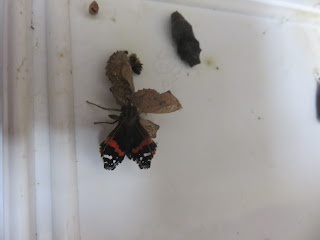
Sometimes the Red Admiral caterpillar will pupate inside their shelters too, but not always, because they will also transform into chrysalises that hang suspended from nettle stalks or possibly on a wall, fence or other object near where the caterpillar has been feeding.
I keep the caterpillars in sandwich boxes with a paper towel on the bottom to help absorb any dampness and to make it easier when cleaning out the container and providing new food. Often I find that the caterpillars will choose to pupate after spinning a pad of silk on the plastic top of the sandwich box. The chrysalises are brown but some are speckled with gold. As the butterfly inside becomes more developed and nears the time for emergence it becomes much darker and you can see the wings colouring up in the wing-case on each side of the chrysalis.

When the Red Admirals finally emerge, or eclose, as lepidopterists would say, they need to dry their wings thoroughly before they take their first flight. It is very important at this stage that they are not disturbed and that they don’t fall off whatever they are clinging to. This can be a problem for all species of butterflies at this stage of their life-cycles. Fallen butterflies can become cripples if they fail to expand and dry their wings properly. Usually all goes well, though, and the Red Admiral is all set to fly away. This butterfly can fly a long way. Many of those seen in the UK are migrants, though this species can hibernate in Britain too. In Portugal they have more than one generation but need nettles. I usually see them in autumn, winter and spring. In summer it is too hot and dry. There is a place in some woodland near where I live that I can almost guarantee I will be able to find a male Red Admiral every year in the right seasons. Of course, it isn’t the same butterfly but is obviously an ideal spot for a male of this species to create a territory he can patrol.

All photos by Steve Andrews

Monday, 28 February 2022

Filming a music video for “Mother Nature Rap.”

 My next release is "Mother Nature Rap."


Photo by Bianca Ferreira
I have a new release coming out on 21 March, as a song and a music video, and it’s a big change of genre for me, because it is entitled “Mother Nature Rap.” I thought that I would take action as a singer-songwriter by becoming a rapper, rapping about threats to the environment. I think I may well be one of the oldest rappers around too, seeing as I will be 69 on my next birthday, which is also on 21 March, the Vernal Equinox and the first day of spring. I recorded the basic song at Verdelho Studio, here in Portugal, with Ricardo Verdelho as my producer and he created the backing rap track behind my vocals and guitar. I sent the result to my good friend Crum, who has been a member of Hawkwind, as well as in Shockhead and The Moonloonies. He has a new band now called STARRATS, and has been a synth player in all these bands. Crum added his synth wizardry to “Mother Nature Rap,” just like he did on my other recent recording, “Time For Ocean Aid.” So my rap song has a distinctive space-rock and synthwave sound to it too. I asked my friend the acclaimed Portuguese filmmaker Pedro Augusto Almeida if he could make a music video for this song, and so it was that I spent 20 February being filmed. We started off at Sergio Dimiendes’s Nimbo Studio in the countryside outside Setubal. Pedro had come up with an opening scene in which I am filmed sat outside the studio reading a newspaper. Maria Calheiros Lucas calls me and I go up some steps and into the studio where I am filmed rapping my song.

Later in the afternoon we went to Sende Portugal, an amazing co-working space, also outside Setubal, and run by Edo Sadikovic and Maruchi Rodriguez. There are acres of woodland and it was in these that I was filmed singing and dancing as the late afternoon sun’s rays grew less, making the lighting conditions a lot better. Taking a short break from the filming, I was introduced to a game known as malha in Portugal but is also called petanque, and is played in France. It employs rather heavy metal balls that players throw into a circle drawn on the ground. I was happy to find that as a newcomer to this game I managed to play well enough, though I failed to win. Pedro’s fiance Bianca Ferreira was in charge of taking all the still photos, and she captured a photo of me holding the malha balls.
After a delicious evening barbecue and meal came the last of the filming for the day. I was dancing and rapping to the camera in a woodland clearing illuminated by coloured lights. And finally I was filmed raising my outstretched arms with a psychedelic video being projected on a screen behind me. I am really looking forward to seeing how the music video turns out but am sure it is going to be as brilliant as Pedro’s other work.  In the meantime, here are the lyrics:

Mother Nature Rap

You wanted a utopia, you’re living in a dystopia,

Too many people with myopia in the world today.

Mother Nature don’t care about neatness, so leave the wildflowers grow,

Help to save the wildlife, you reap what first you sow,

Mother Nature ain’t here for your dream, you’re in hers so let it be,

Respect all her creation, and go and hug a tree,

But all the forests you’ve cut down, you know that should never have been,

The Mother’s lungs have been cut out, it’s happened but it’s obscene.

The oceans you’ve filled with plastic, and the land you’ve poisoned badly,

We’re in the beginning of the end, and the future’s looming sadly.

The children know what’s happening, and the grown-ups have let them down,

The Arctic ice is melting, and the cities on the coasts could drown.

You wanted a utopia, you’re living in a dystopia,

Too many people with myopia in the world today.